Hydrogen ground equipment runs full aircraft turnaround at Exeter
There’s a lot going on when a commercial jet lands. It needs power, it needs towing, it needs its luggage moved.
At Exeter Airport, that job has always fallen to diesel-powered machinery – noisy, polluting, but undeniably effective… Until now.
This week, the full fleet of turnaround machines completed the task running on completely green and CO2-free hydrogen.
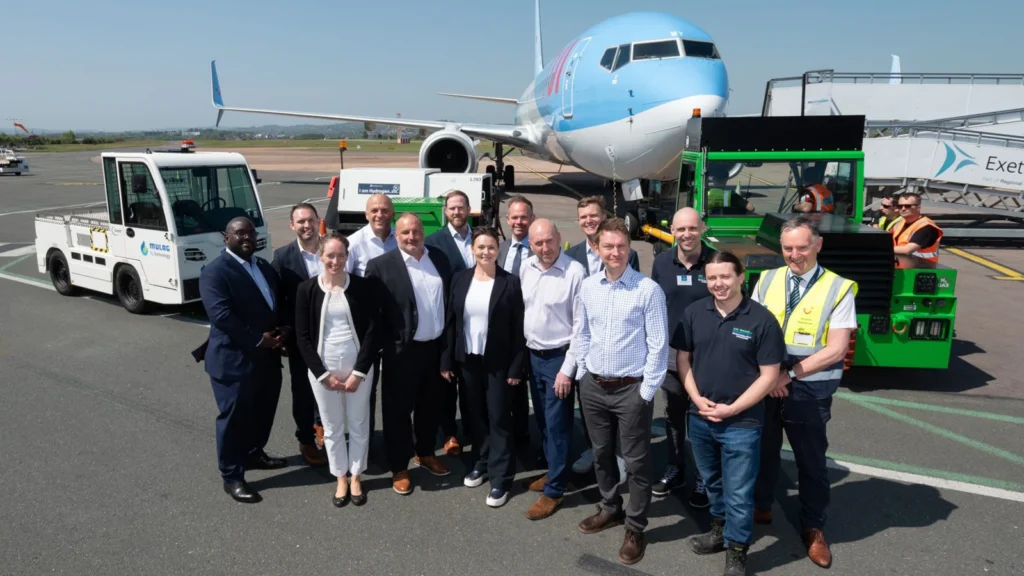
Part of the UK Civil Aviation Authority’s Hydrogen Challenge, this demonstration of British ingenuity saw ground support equipment (GSE) including a tug, a baggage tractor, and a ground power unit all run on hydrogen – some using hydrogen combustion, some using hydrogen fuel cells.
It was the first time in the UK that every part of a turnaround has been handled by hydrogen machinery operating live on a commercial apron.
MATT – hydrogen hybrid tug
The centrepiece was MATT: the Medium Aircraft Tow Tug developed by Liverpool-based ULEMCo which has been completely rebuilt from a legacy diesel platform. It now runs on a hydrogen-electric setup, similar to a hybrid.
A compact hydrogen internal combustion engine acts as a generator, recharging a small onboard battery that then drives twin electric wheel motors.
The engine runs lean, keeping NOx output to ultra low levels while completely eliminating CO₂ entirely.
Just five kilograms of compressed hydrogen is enough to keep the tug operational throughout the full work day, with quick refuelling handled via a 350-bar mobile HyQube dispenser supplied by Fuel Cell Systems Ltd.
The hydrogen itself was green, produced by Protium from renewable electricity.
Supporting kit: fuel cell and hybrid
MATT was joined by a hydrogen fuel cell baggage tug and a hybrid ground power unit that uses both diesel and hydrogen to supply electrical power to the aircraft while on stand.
Together, the machines handled all airside activity needed to turn the aircraft around, without reliance on grid-charged battery packs or standard diesel equipment.
The work was carried out under real operating conditions on a live ramp, with the TUI aircraft in service.
Diesel use at airports
Some boffins at Cranfield University have done some calculations, and the sheer amount of emissions used just in aircraft operations is staggering.
According to the study, Exeter Airport’s ground operations alone uses near-as-dammit 80,000 litres of diesel per year, producing close to 200 tonnes of CO₂ equivalent. Ground power units alone account for nearly 40% of that.
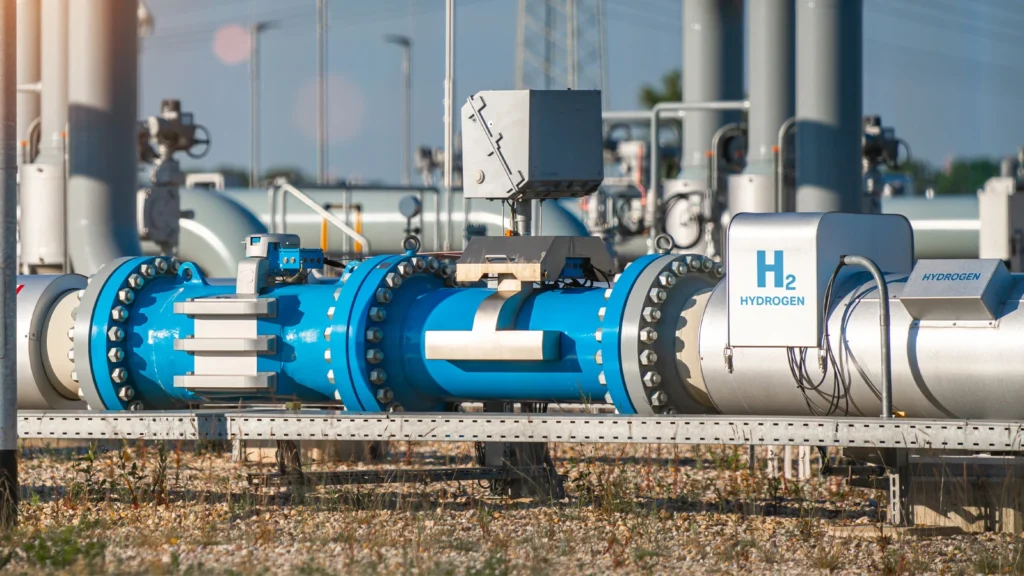
Each of the machines used in this hydrogen trial targets one of those emissions sources directly – and does so using tech that’s available right now.
The baggage tug ran its duty cycle on hydrogen fuel cell power, and the hybrid GPU demonstrated a transitional approach for equipment not yet suited to full zero-emission conversion.
Cranfield will use operational data from the demonstration to help develop future safety and performance standards for hydrogen machinery operating in live aviation environments.
Retrofit, not rebuild
ULEMCo’s approach with MATT also offers a route for decarbonisation that doesn’t depend on buying entirely new equipment.
The tug uses an existing diesel chassis, now powered by a hydrogen combustion generator and electric drive motors.
The control system ensures the engine only runs in its most efficient zone, extending runtime and reducing local emissions even further.
The machine was built to operate in a live commercial setting with no change to infrastructure beyond fuel supply. It’s already compatible with existing duty cycles, weight requirements and operator workflows.
“The number of hydrogen technologies on show here demonstrates the versatility of this clean fuel”, said Amanda Lyne, Managing Director of ULEMCo.
“As real-world examples of hydrogen fuel usage increase, the case for investment in UK-wide refuelling infrastructure grows ever stronger.”
These were working machines operating in a live, time constrained, and highly regulated environment – towing, charging, transporting – without diesel and without delay.
It shows hydrogen machinery is not just viable – it’s ready to go, it’s ready to work, and it works exactly where it’s needed most.