Europe’s most powerful hydrogen station launched – as H2 MOBILITY retools its network for real demand
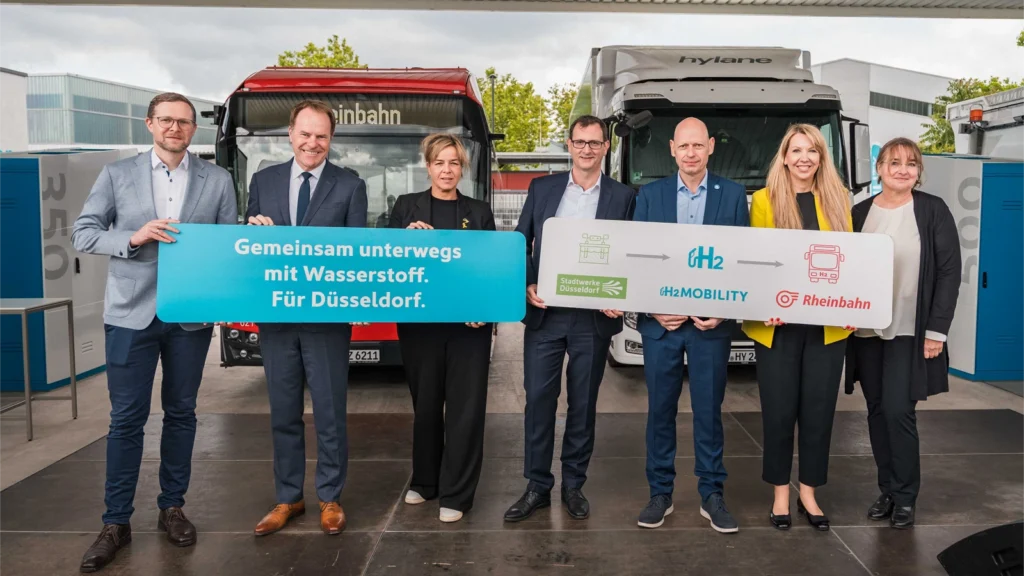
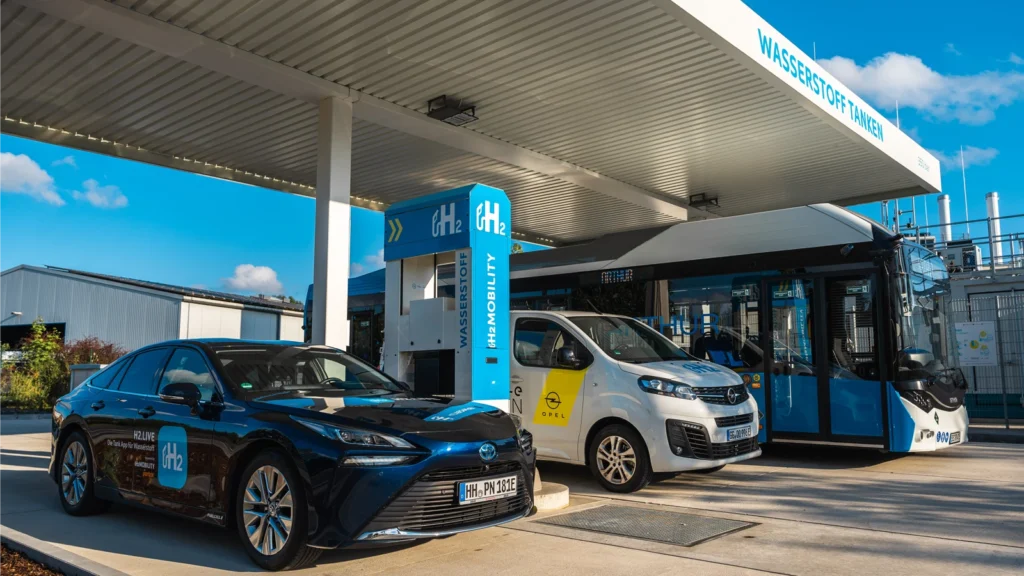
H2 MOBILITY has opened what it calls the most powerful hydrogen refuelling station in Europe, right in the heart of Düsseldorf.
With a maximum capacity of five tonnes per day and the ability to refuel three vehicles at once across 350, 500, and 700 bar, the new station on Höherweg is built for the next wave of hydrogen mobility.
Coming at a pivotal time for the company, earlier in the year, H2 MOBILITY confirmed it would shut down 22 underused 700-bar hydrogen stations across Germany – many of them built years ago to cater for private cars that never quite came in the numbers hoped for.
Critics claimed the closures marked a retreat from hydrogen mobility altogether. This new station shows that’s not the case.
Instead of pulling back, H2 MOBILITY is doubling down – just not in the same way. It’s shifting focus to where demand is already arriving – fleet operators, buses, logistics, and local authorities – but the company isn’t turning its back on cars either.
“This station marks a milestone for hydrogen mobility in Europe,” said H2 MOBILITY COO Frank Fronzke.
“It represents a new generation of hydrogen refuelling stations, with more dispensers for 350, 500 and 700 bar, greater hydrogen volumes and significantly higher performance.
“Our innovative high-performance technology enables fast, flexible refuelling for buses, trucks and passenger cars, making a tangible contribution to the transport transition.”
Car-only stations out, commercial demand in
The Düsseldorf station is a textbook example of what hydrogen infrastructure looks like when it’s placed correctly in the middle of a use case.
Built in partnership with Stadtwerke Düsseldorf and public transport operator Rheinbahn, it sits just around the corner from Rheinbahn’s Lierenfeld depot, where 20 hydrogen buses are already in service.
Rather than building infrastructure and hoping demand will follow, the partners have done it the other (correct) way round – linking supply, vehicles, and refuelling into a single joined-up concept.
The station will initially be supplied with certified renewable hydrogen. From next year, it will be fed directly by a two-megawatt electrolyser behind the site, powered by ‘biogenic’ electricity from the city’s waste-to-energy plant. Local waste in, local fuel out. Simple.
As the electrolyser comes online in 2026, the station will become one of Europe’s first circular hydrogen loops – no long-distance trucking of gas, no emissions, no nonsense.
Strategic shift, not strategic retreat
When H2 MOBILITY began closing 700-bar stations earlier this year, it made headlines for all the wrong reasons.
But those closures weren’t a signal of defeat – they were a realignment. Most of the sites being decommissioned were small-scale, early-generation stations that had seen little use. The numbers didn’t stack up.
“Older, small refuelling stations with a focus on passenger cars… must be removed from the network where this is unavoidable,” the company explained at the time.
That doesn’t mean hydrogen cars are off the cards. What it means is the network is being optimised to handle the demand that’s already here, while remaining open to the demand that’s still growing.
And it’s increasingly clear where that early demand is coming from – fleets, buses, refuse trucks, vans, and operators with predictable routes and tight schedules.
In that context, the Höherweg station is a glimpse of what’s to come, with fewer pump-island experiments, more strategic high-throughput infrastructure. Built for heavy use, but open to all.
Joined-up, funded, and ready to scale
Backed by €3.1 million in federal funding, with an additional €1.2 million for the electrolyser, the project is part of Germany’s wider National Innovation Programme for Hydrogen and Fuel Cell Technology. It also slots into the state-level HyTrucks NRW and 1,000 Fuel Cell Buses NRW initiatives.

The site is already proving its worth for Rheinbahn. “The new station ensures our hydrogen buses can be refuelled flexibly and efficiently,” said board member Annette Grabbe. “It’s a key step in our strategy to reduce CO₂ emissions and run reliable, clean services.”
The station also contributes to Düsseldorf’s broader climate goals, with the city targeting net-zero by 2035, and Mayor Dr Stephan Keller calling the launch “a win for both climate protection and modern urban mobility.”
The long game
H2 MOBILITY turns ten this year. In that time, it’s helped shape one of the most advanced public hydrogen refuelling networks in the world.
But even with 90 stations, a growing fleet of trucks and buses, and plans to go 100% renewable by 2028, there’s still work to do.
The big lesson is that hydrogen needs to be where the hydrogen vehicles are.
This isn’t the end of hydrogen for cars. But it is the start of a more mature phase – one where infrastructure follows real usage, and builds momentum from the ground up.
And if you turn up in a hydrogen car? They’ll still take your money.