Hydrogen in transport: BMW, Daimler, Toyota panel calls for German national masterplan
A high-level panel in Berlin has called for a coordinated “Masterplan Wasserstoff im Verkehr” – “Hydrogen Masterplan for Transport” in English – to accelerate the use of hydrogen in Germany’s transport sector.
The discussion, held on 23 September under clear skies in the capital, brought together Dr. Jürgen Guldner of BMW, Volker Hasenberg of Daimler Truck, André Steinau of GP Joule and Stephan Herbst of Toyota.
They were joined by members of the Bundestag, the Federal Ministry for Digital and Transport (BMDV), and other invited guests.
Enough hydrogen to go around
According to the speakers, Germany will have sufficient hydrogen available for transport without disadvantaging other sectors.
They argued that reaching cost parity with diesel is achievable sooner than parity with natural gas, meaning road transport could act as a catalyst for scaling up the wider hydrogen economy.
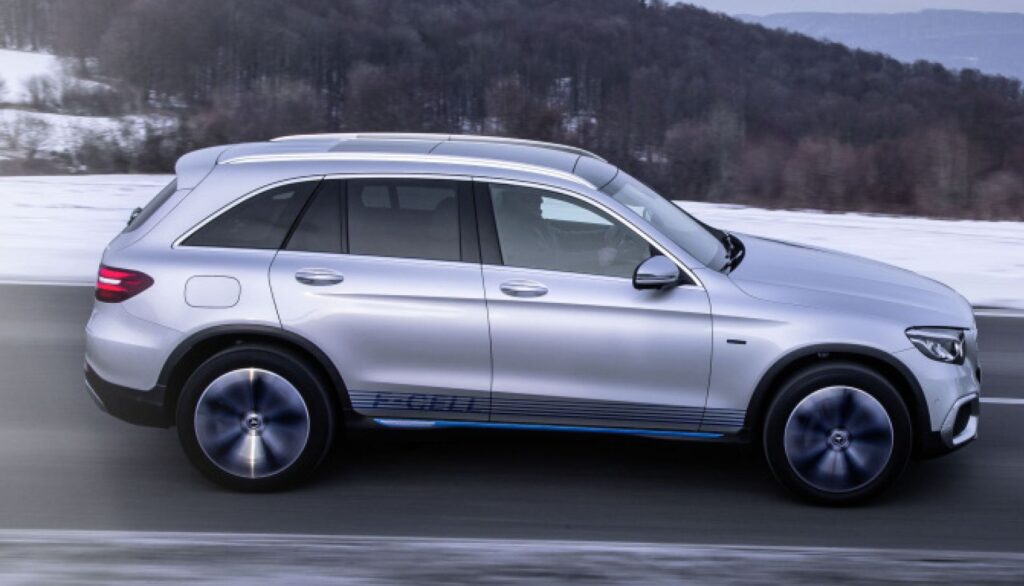
Hydrogen vehicles were described as combining the benefits of electric driving – zero local emissions and quiet operation – with the convenience of fast refuelling.

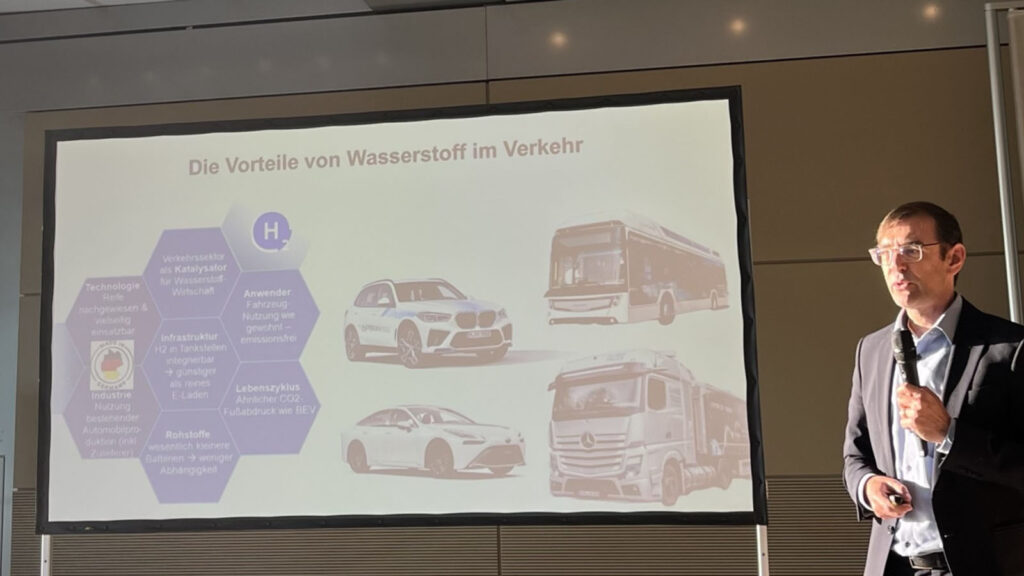
Dr. Guldner presented a slide showing hydrogen cars, buses and trucks, alongside the message that for drivers, the experience is “as usual – but emission free.”
The panellists stressed that fuel cells are a sensible complement to battery-electric mobility across all vehicle segments.
Technology and value chain readiness
The group pointed out that fuel cell technology has already been proven in multiple applications and is versatile in use.
They also highlighted that Germany and the wider EU already possess the full value chain to produce hydrogen vehicles – from OEMs to suppliers – meaning the industrial base is in place.
The presentation also noted that hydrogen fuel cell vehicles require significantly smaller batteries than pure BEVs, reducing dependency on critical raw materials.
In terms of lifecycle emissions, the CO₂ footprint of fuel cell vehicles was said to be similar to that of battery-electrics.
Infrastructure economics
One of the sharper messages concerned infrastructure. Hydrogen can be integrated into existing filling stations, the panel said, and in the long run this could prove cheaper than relying on an all-electric charging network.
They warned that scaling up EV charging requires heavy grid expansion, which becomes exponentially more expensive at higher volumes.
The session closed with agreement on the need for a clear national plan to coordinate the rollout of hydrogen in transport.
The speakers said this orchestration should be anchored in Germany’s National Hydrogen Strategy to provide industry and policymakers with a common roadmap.