Could hydrogen fuel cells be the right choice for data centres?
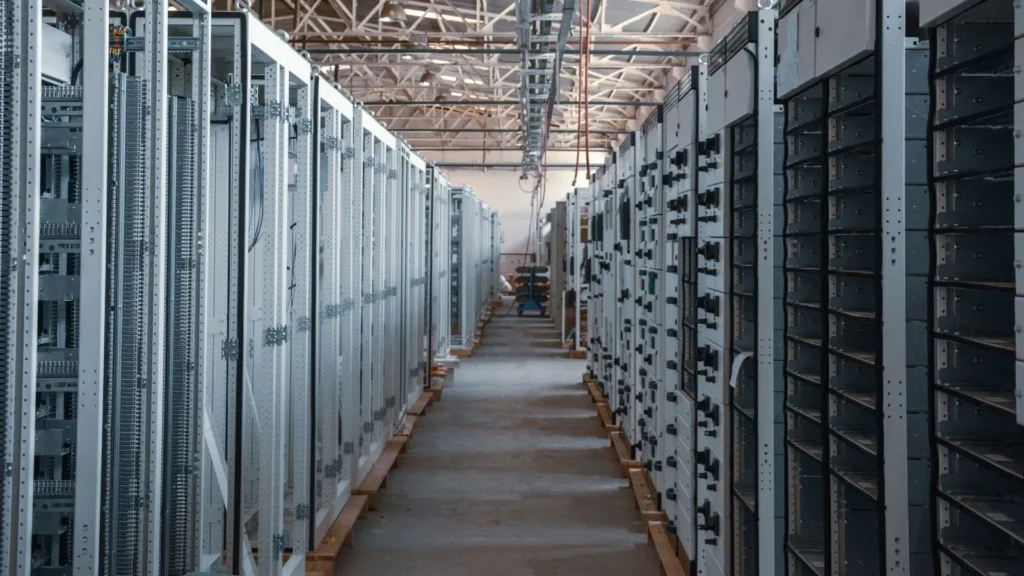
Data centres are the backbone of our digital world. They power everything from your latest AI chatbot to cloud storage, video streaming and online banking. But as these digital warehouses scale up, so too does their energy footprint.
In fact, according to the Environmental and Energy Study Institute (EESI), data centres could account for up to 12% of the U.S. annual electricity demand by 2030. With the AI boom accelerating that demand, the pressure is on to find reliable, sustainable power solutions.
That’s where hydrogen fuel cells are entering the conversation.
A growing chorus of technology firms, energy giants and equipment manufacturers now say hydrogen fuel cells offer a compelling alternative to traditional diesel generators.
Could this be the beginning of a cleaner, quieter, and more resilient future for data infrastructure?
Why hydrogen fuel cells?
Hydrogen fuel cells generate electricity through an electrochemical reaction — not combustion — with the only byproduct being water vapour. Unlike diesel generators, fuel cells are virtually silent, vibration-free, and emissions-free when powered by green hydrogen.
In theory, that makes them perfect for the power-hungry world of data centres.
But what about the real world?
In real-world data centre environments, one of the biggest operational headaches is heat. Diesel generators generate massive amounts of it through combustion, which demands extensive cooling systems to prevent overheating. These active cooling systems consume additional energy, create noise, and require physical infrastructure that adds complexity and cost.
Hydrogen fuel cells, by contrast, produce far less waste heat. Because they generate electricity through an electrochemical reaction rather than combustion, they operate at lower temperatures and more consistent thermal levels. This significantly reduces the cooling burden on site, and in some cases may even allow for passive thermal management — particularly valuable in high-density edge locations or containerised modular builds.
That also makes fuel cells more environmentally friendly in terms of thermal efficiency. Less heat generation means lower cooling requirements, and lower cooling demands reduce the overall energy footprint. In certain applications, waste heat from fuel cells can even be captured and reused. Although, that’s more common in commercial or residential combined heat and power systems than hyperscale data centres.
All told, when it comes to cleaner, quieter, and cooler backup or prime power, hydrogen fuel cells can offer a major advantage — not just in emissions, but in thermal simplicity too.
The fuel cell advantage
According to Hitachi Energy, which has been researching the potential of hydrogen for backup power, fuel cells can run continuously for hours or even days, offering more scalable uptime than batteries. They’re also modular, meaning operators can scale them based on facility size.
Plug Power adds that their PEM fuel cell systems deliver high efficiency and reliability, with much lower maintenance needs than combustion-based gensets. That lowers operational costs over time — even if upfront investment is still relatively high.
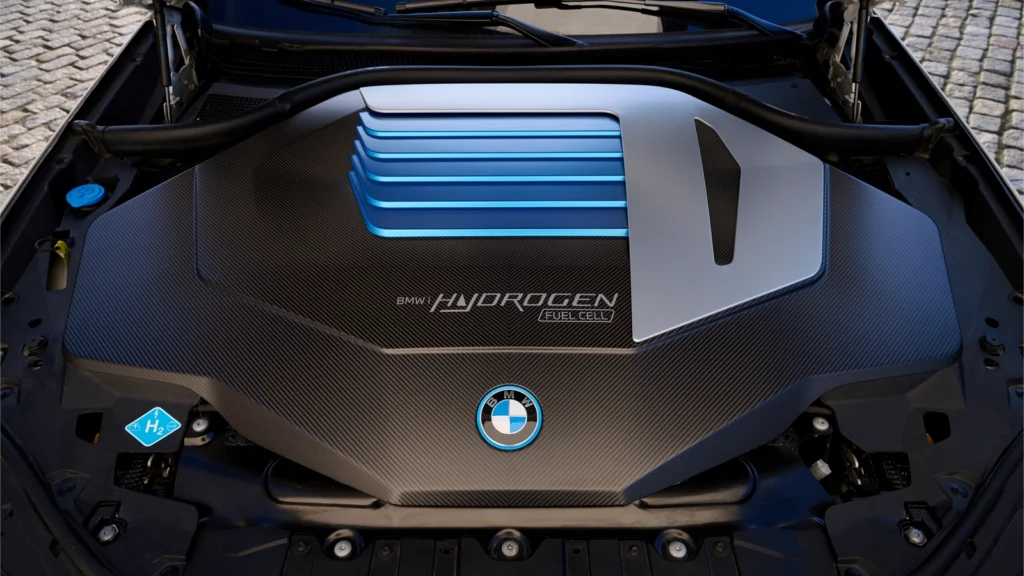
Microsoft’s high-profile hydrogen trials in 2020 and 2023 demonstrated a 250 kW PEM fuel cell running for 48 hours without issues. Their project lead described it as a “game-changer” for backup power.
FuelCell Energy points out that fuel cells not only provide zero-emissions power, but also help reduce grid dependence. That’s a major plus in places where power grids are under pressure or highly carbon-intensive.
GeoPura and Intelligent Energy both stress hydrogen’s flexibility. Whether for peaking, standby or even baseload, hydrogen fuel cells provide uninterrupted power without the usual baggage — noise, emissions or diesel logistics.
AI’s power problem — and why hydrogen helps
As AI workloads grow, data centre power needs are exploding. Analysts suggest AI training models can draw multiple megawatts per rack. This is pushing traditional infrastructure to the limit.
Bloom Energy, one of the global leaders in fuel cells, argues that hydrogen-based systems are particularly well suited to high-density AI campuses because they can deliver clean megawatts at scale, close to where it’s needed.
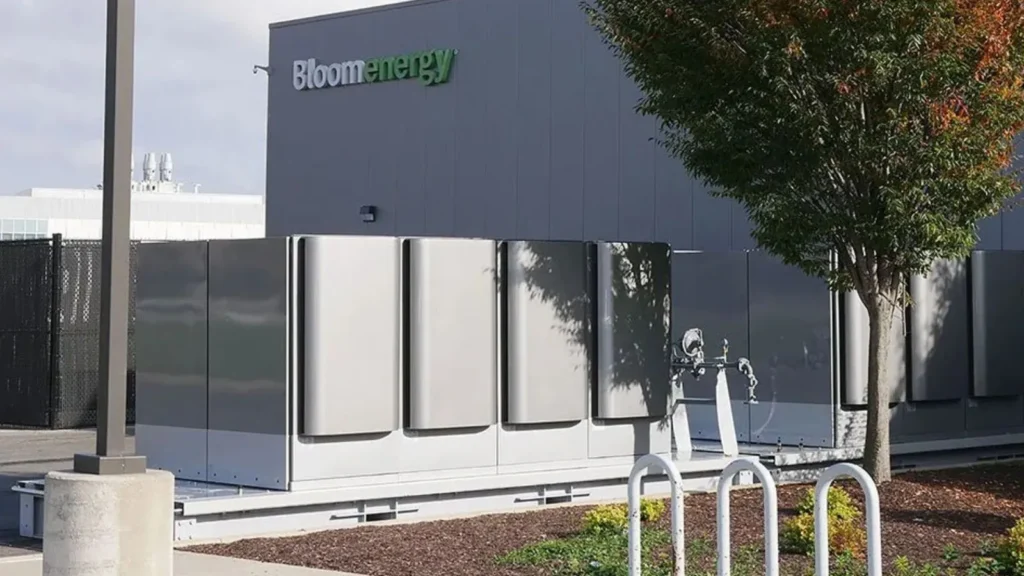
In fact, Bloom has already signed a $5 billion agreement with Brookfield to power AI-focused campuses using its fuel cell technology. These systems don’t rely on intermittent renewables or long-distance transmission — they sit on-site, provide constant power, and can be deployed incrementally.
For operators running GPU-intensive AI clusters with 24/7 uptime requirements, this is a major win.
Grid strain and hydrogen’s off-grid advantage
The explosive growth of data centres is creating serious challenges for electricity grids. Goldman Sachs predicts a 165% increase in global data centre electricity demand by 2030, while Aurora Energy Research warns that new data centres in the UK could significantly strain local infrastructure — leading to higher connection delays, capacity shortfalls, and rising costs.

In parts of Europe, Ember reports that electricity grid congestion is already impacting data centre planning and investment. And while hyperscale players are exploring grid-connected renewables, they often face limits on capacity, permitting delays, or curtailment risks.
Hydrogen fuel cells offer a viable off-grid or hybrid solution. By generating power on-site, data centres can sidestep grid constraints entirely or support the grid during peak loads. Companies like GeoPura, Microsoft and Bloom Energy are all investing in distributed fuel cell systems as a way to reduce their dependence on the fragile electricity networks they currently rely on.
GeoPura’s perspective on hydrogen for data centres
GeoPura, a UK-based leader in clean hydrogen energy, sees hydrogen fuel cells as a practical answer to the increasingly urgent energy demands of hyperscale data centres.
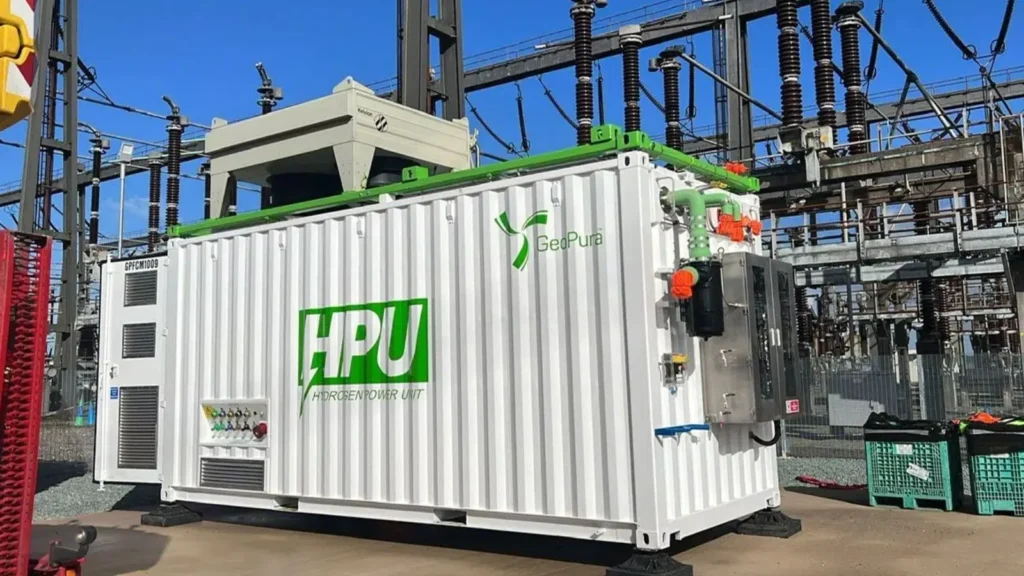
They argue that battery storage alone will not be enough to guarantee consistent, high-quality power, especially as data infrastructure expands. With hydrogen, backup systems can operate for longer durations and provide consistent voltage without degradation. This makes them better suited for applications where milliseconds of downtime could cost millions.
GeoPura also highlights that fuel cells can be deployed far more flexibly — serving as both primary and standby power, reducing grid demand, and making sites more resilient in emergencies or outages.
Who’s already moving on this?
Hydrogen fuel cells in data centres are no longer hypothetical. Here’s a look at who’s already putting it into practice:
| Company | Project Location | System Size | Fuel Cell Provider |
| Bloom Energy | Global (US, Asia, Europe) | 400+ MW total | Bloom Energy |
| Microsoft | US test sites (WA, CA) | 250 kW (pilot) | Plug Power / Custom |
| EdgeCloudLink | US Midwest | 1 MW now, 1 GW planned | Unknown |
| CoreWeave (via Bloom) | Illinois, US | Multi-MW | Bloom Energy |
| Intel | Santa Clara, US | MW-scale | Bloom Energy |
Many of these projects are pilots or in early-stage deployment — but they’re real. And they’re setting the groundwork for much wider adoption.
Green or grey hydrogen?
Not all hydrogen is created equal. The environmental benefit of fuel cells hinges on the source of hydrogen.
- Green hydrogen is made by splitting water using renewable electricity. It’s the cleanest option.
- Grey hydrogen is made from natural gas and produces carbon emissions.
- Blue hydrogen is grey hydrogen with carbon capture attached.
Right now, many deployments rely on delivered hydrogen — sometimes grey, sometimes green. For example, EdgeCloudLink receives tanker deliveries every two weeks. Others are working towards on-site production using electrolysers, often powered by surplus renewables. GeoPura promotes this model as the most future-proof, resilient and clean.

Long term, on-site green hydrogen production is seen as the goal. That would turn data centres into self-reliant, zero-emission microgrids — a powerful vision for an industry often criticised for its carbon intensity.
What are the barriers?
While the potential is huge, some challenges remain:
- Cost: Fuel cells and green hydrogen are still expensive, though prices are falling fast.
- Hydrogen infrastructure: Distribution, storage and fuelling are still maturing.
- Space: Some hydrogen systems require additional safety and ventilation infrastructure.
But the tech is progressing rapidly. Governments are supporting hydrogen infrastructure. And hyperscale players are investing billions — a strong signal of confidence.
So, is hydrogen the right fit?
For traditional backup power needs? Fuel cells are already proving themselves. For AI mega-facilities? Hydrogen’s potential to deliver clean, dense, 24/7 power makes it one of the few scalable options.
As data centres become critical infrastructure, the need for clean, independent and resilient power only grows. Hydrogen fuel cells might not be the sole answer — but they’re increasingly looking like an essential part of the puzzle.
And in an era defined by data and climate, that’s exactly what the world needs.