Lhyfe opens Germany’s largest renewable hydrogen production site in Baden-Württemberg
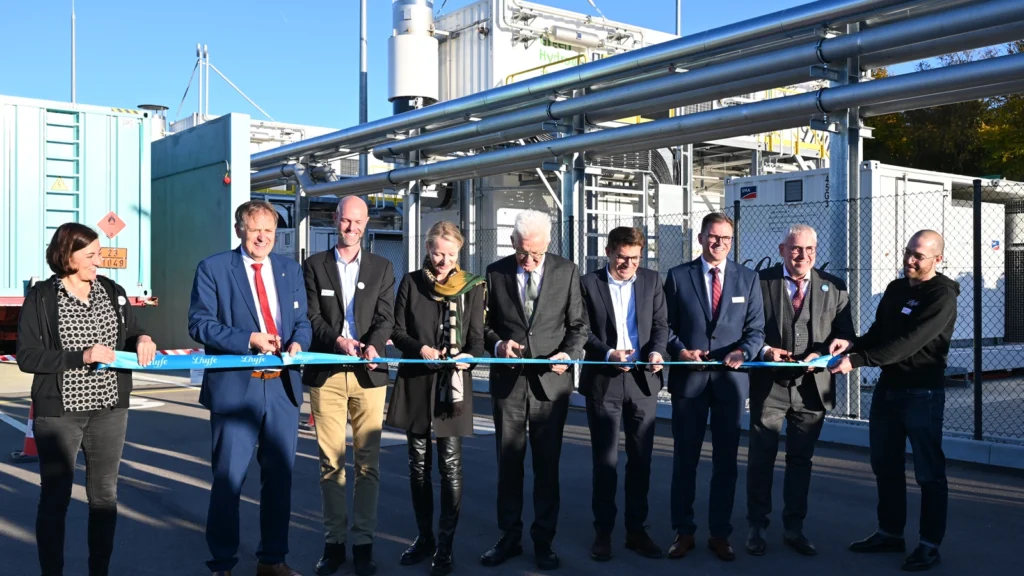
French hydrogen producer Lhyfe has officially inaugurated its first German production site in Schwäbisch Gmünd, Baden-Württemberg – a 10 MW facility capable of producing up to four tonnes of renewable hydrogen per day, making it Germany’s largest commercial renewable hydrogen plant to date.
The site, completed at the end of 2024, is currently undergoing reliability testing before full-scale commercial operations begin in the coming months. It received RFNBO certification in September 2025 – confirming compliance with the EU’s most stringent sustainability criteria for renewable hydrogen.
A hectare of hydrogen
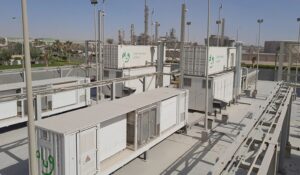
Built on a one-hectare plot in Schwäbisch Gmünd, the facility uses water electrolysis powered entirely by renewable electricity, secured through power purchase agreements (PPAs) with producers including EDPR.
The system is arranged in containerised, stackable modules that handle the full process – from water treatment and electrolysis to purification, compression, and filling. The site’s truck filling stations enable tube trailers to collect hydrogen for delivery across the region.
At full capacity, the site will generate enough hydrogen to power around 100 trucks for 400 km each day without emitting CO₂.
Feeding Germany’s hydrogen backbone
The Schwäbisch Gmünd plant is designed to serve both mobility and industrial users across southern Germany. Lhyfe has already agreed to supply hydrogen to H2 MOBILITY, the country’s largest refuelling network operator, and plans to feed a new regional distribution station in Schwäbisch Gmünd itself.
In industry, the site could support sectors including chemicals, steel, and glass, as well as the proposed H2-Aspen industrial zone – a planned hub for hydrogen-powered manufacturing.
The €6.4 million project received public funding from the State of Baden-Württemberg (€2.1 million) and the European Union (€4.3 million) through the European Regional Development Fund, as part of the H2-Wandel model region programme.
RFNBO-certified hydrogen
Certification under the Renewable Fuels of Non-Biological Origin (RFNBO) standard confirms that hydrogen from the site is 100 per cent renewable and meets strict traceability and environmental requirements under the EU Renewable Energy Directive and EU Taxonomy.
For customers, this ensures eligibility for national and European incentive schemes, with full proof of origin for the hydrogen purchased.
Building on a five-year German presence
Lhyfe has operated in Germany since 2020, initially developing a hydrogen unit in Baden-Württemberg for Deutsche Bahn’s “H2goesRail” project. The company began delivering renewable hydrogen to German customers in 2023 and now manages one of Europe’s largest tube-trailer fleets, with 70 high-performance containers ranging from 380 to 1,000 kg capacity.
Across Europe, Lhyfe made more than 470 hydrogen deliveries in 2024 with a 99 per cent service rate – a record the company says demonstrates the maturity of its supply chain.
A growing European footprint
Founded in Nantes in 2017, Lhyfe was the first company in the world to link an industrial-scale hydrogen plant directly to a wind farm (2021), and later launched the world’s first offshore hydrogen production platform (2022).
With three sites operational in France and now a fourth in Germany, Lhyfe is expanding across 12 European countries with several new facilities under construction.
Luc Graré, Lhyfe’s Head of Central & Eastern Europe, said the Schwäbisch Gmünd site marks “a new chapter in Lhyfe’s history in Germany” and will enable “ever-increasing volumes” of hydrogen supply, including future on-site production units for industrial customers.
Political support for hydrogen in Baden-Württemberg
At the inauguration, Winfried Kretschmann, Minister-President of Baden-Württemberg, described the plant as “an important step forward in ramping up hydrogen technology” for the state.
Thekla Walker, Baden-Württemberg’s Environment Minister, added: “We have to play an important role in the international hydrogen market. To do so, we need to overcome challenges from infrastructure to costs… pioneers like Lhyfe are paving the way to a sustainable and climate-neutral future.”