Daimler Truck delays GenH₂ fuel cell truck ramp-up to post-2029, shifts focus to Europe

Daimler Truck has confirmed it will delay the high-volume industrialisation of its GenH₂ hydrogen truck to after 2029, citing limited infrastructure growth and a slower-than-expected policy environment – particularly outside Europe.
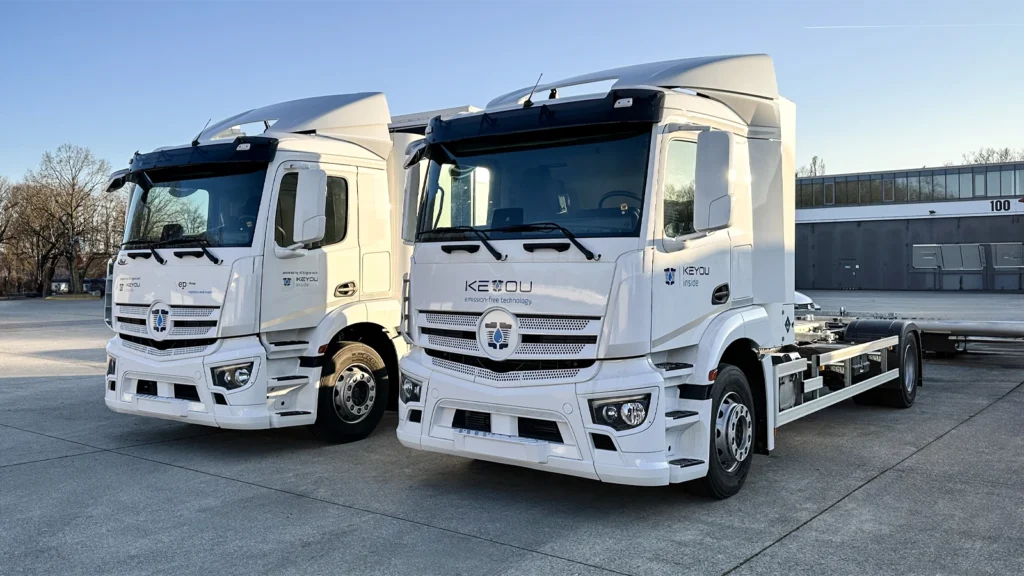
While the truck itself remains on schedule and is currently in customer testing, the company said it would now prioritise “preparing market ramp-up for >2029 with lower volume and focus on Europe first.”
The update was presented during Daimler Truck’s Capital Market Day 2025, where the firm outlined a series of changes to its zero-emission roadmap across fuel cell, battery-electric, diesel, and software platforms.
Infrastructure not moving fast enough
The decision reflects what Daimler calls the “speed of right” – a flexible, region-sensitive approach to decarbonisation that matches industrialisation to real-world market readiness. In the case of hydrogen trucks, that means slowing down.
According to the firm’s Head of Truck Technology, Andreas Gorbach, the transformation speed for hydrogen is now diverging globally.
In Europe, Daimler will continue preparing the GenH₂ for limited rollout, but large-scale production has been pushed into the next decade.
The presentation confirms that Daimler is “keeping time to market” for the GenH₂ itself – but will “decelerate industrialisation of fuel cell” systems.
Industrial scale-up through Cellcentric, the company’s joint venture with Volvo, will also be delayed, with Daimler saying it will increase scale “with additional customers and partners.”
Still betting on fuel cells – but playing the long game
Importantly, Daimler Truck is not backing away from hydrogen. In fact, it still refers to its fuel cell technology strategy as a “dual decarbonisation” approach, and retains a global fuel cell platform that it intends to scale “once global volumes justify.”
Gen1 fuel cells are already in customer tests, and Gen2 development is underway. Daimler’s long-haul hydrogen demonstrator – the liquid hydrogen GenH₂ – has already proven over 1,000 km of range on a single fill. But without refuelling stations, that’s where progress ends.
Battery slowdown in US, diesel legacy extended
The company also confirmed it is slowing investment in its global battery platform, particularly in the US, due to “deceleration of decarbonisation” and patchy regulatory support.
Heavy-duty diesel, by contrast, is being extended – with a new 2027 engine platform in development and production projected to continue “well beyond 2030.”
Daimler’s flexible platform strategy means it can “execute at the speed of right” – a phrase repeated throughout the Capital Market Day slides – enabling it to back hydrogen in Europe while pulling back elsewhere.
Europe the last man standing?
For now, Europe appears to be Daimler’s last major beachhead for hydrogen trucks. The firm will focus on customer testing, pilot-scale deployments, and “maintaining time to market” in the region – but has made no promise of series production before 2030.
The GenH₂ isn’t dead. It’s just been parked up while the world builds the pumps.