Luxfer launches engineering support programme for hydrogen and CNG fuel systems
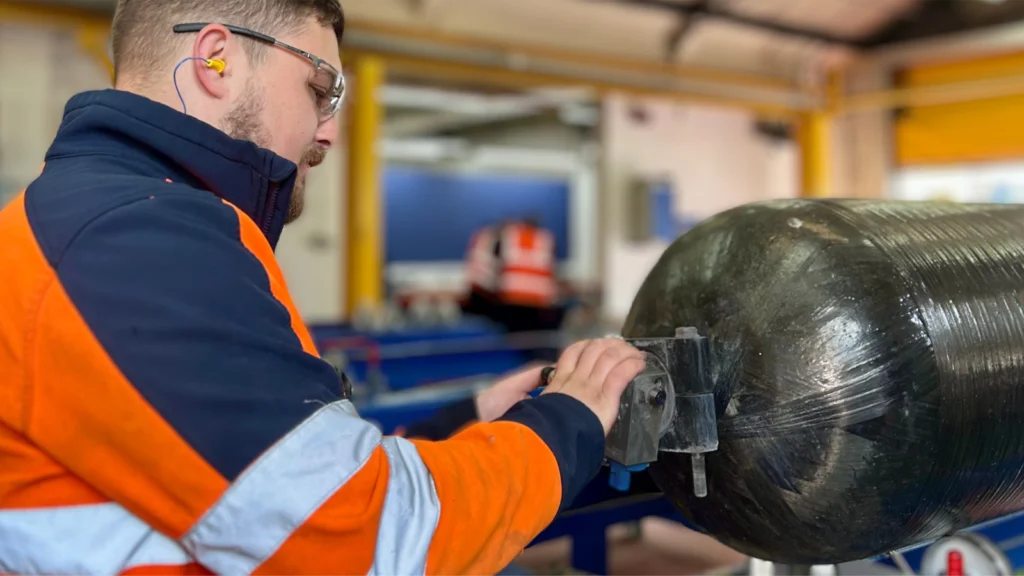
Luxfer Gas Cylinders has launched a dedicated support service for hydrogen and compressed natural gas (CNG) fuel systems, aiming to plug a persistent gap in post-installation maintenance across the sector.
Called Luxfer Care, the programme offers technical assistance, warranty repairs and system diagnostics for mobility and energy projects using pressurised gas storage – including those not originally built by Luxfer.
A small field team of engineers has already begun working with more than two dozen companies across the UK, Europe and North America.
The initiative reflects a growing need for hands-on technical support as hydrogen systems move from one-off prototypes to operational assets.
According to Luxfer, the aim is to reduce downtime, resolve component issues, and ensure that complex systems continue operating safely once deployed in the field.
“There’s a real shortage of qualified support for hydrogen systems,” said Alex Millward, who leads the three-person team. “Operators often come back to the OEM with problems and find there’s no one to help. That’s where we’ve stepped in.”
Supporting first-of-a-kind hydrogen projects
Among the early recipients of Luxfer Care support is the UK’s first hydrogen-powered train, developed for a public demonstration ahead of COP26.
Luxfer had originally supplied the onboard storage system but was later brought back in to carry out six months of iterative testing and fault diagnosis.
In another case, the team supported a prototype hydrogen-powered canal boat built with third-party components. The vessel had been left immobile at its dock over winter due to refuelling issues, which Luxfer engineers traced back to misconfigured parts.
Other projects include fleet support for a UK hydrogen bus manufacturer, on-site assistance with hydrogen terminal tractors in Germany and Texas, and advisory input on storage systems for marine and off-road vehicles.
“We’re seeing a lot of cases where components are being misused or installed incorrectly,” said Ash Brodsky, a field engineer on the team. “These are new technologies and most of what we’re supporting are prototypes. It’s often not clear where the fault lies until we get hands-on.”
Spare parts to full-service support
What began as a spare parts programme has since evolved into a broader support offer, covering, installation, diagnostics, technical assistance and repairs.
Customers can also access pre-approved components and tooling – often difficult to source or identify independently, especially in the case of bespoke hydrogen systems involving dozens of suppliers.

Luxfer says that while the market for gas cylinder systems has grown steadily in recent years, post-delivery engineering support has failed to keep pace. In hydrogen mobility especially, expertise remains thin on the ground once systems leave the workshop.
“We’re not trying to sell people new systems,” Millward said. “We’re focused on keeping the ones already out there working properly. That’s the part nobody else seems to be doing.”
A small team, covering a wide map
Based in Nottingham, the Luxfer Care unit operates as a mobile engineering service. Between them, the three engineers have supported projects in France, Germany, the US and South Korea – as well as throughout the UK and Ireland.
Stuart Fletcher, one of the Engineers who joined the team earlier this year after working on plant machinery and generator systems, said hydrogen presented a new set of challenges. “You’ve got to figure out how these systems behave in real conditions – not just on a screen. And if something’s not right, you’re the one expected to sort it.”
Luxfer claims the Care team is currently the only one of its kind in Europe offering third-party hydrogen support at this level.
While the market remains relatively small, the firm believes demand will increase as more operators run hydrogen vehicles and vessels in day-to-day service.