“Think hydrogen, think Scotland”: Scotland positions itself as a “hydrogen nation”
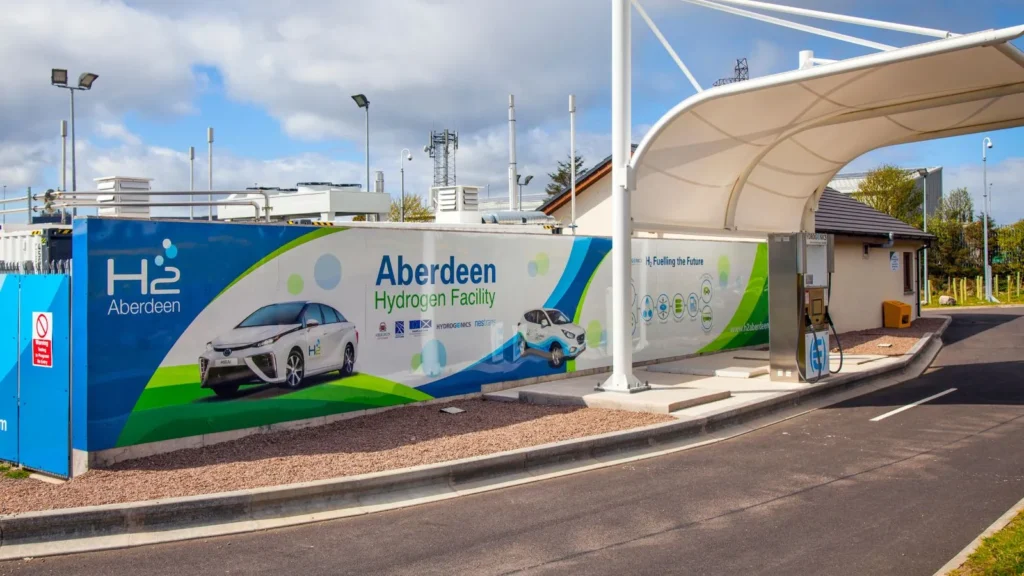
Scotland is positioning itself as a “hydrogen nation” with world-first hydrogen demonstration projects and 13 Regional Hydrogen Hubs.
Scottish Development International (SDI) has announced ambitious goals of becoming the world’s leading hydrogen producer, laying out a detailed plan supporting the local hydrogen industry.
“In Scotland, we’re building a hydrogen economy. Now is the perfect time to join us and access the rewards of the hydrogen revolution,” says SDI on its dedicated hydrogen page.
The plan
13 Regional Hydrogen Hubs are being built across Scotland with the aim of widening opportunities for investment in hydrogen energy. These hubs host the “entire hydrogen life cycle”, from production to storage to end use.
| Hub Region | Key highlights |
| Aberdeen | Two hydrogen refuelling stations, fleet of hydrogen vehicles, and the new South Harbour Energy Transition Zone (ETZ) hub |
| Argyll and Islands | MACC Hydrogen Futures project at Machrihanish Airbase aims to produce and distribute green hydrogen |
| Ayrshire | Hunterston site + Prestwick Aerospace set to support hydrogen production, export and aviation sector |
| Cromarty | North of Scotland Hydrogen Programme aims for full hydrogen economy: production, storage, distribution |
| Dumfries & Galloway | Hydrogen supply chain cluster, 11% of Scotland’s renewables, Chapelcross site key to future projects |
| Dundee | Plans for hydrogen vehicle fleets, refuelling and production. MSIP focuses on low-carbon innovation |
| Fife | World-first H100 project to supply 300 homes with 100% green hydrogen by 2025 from offshore wind |
| Glasgow | Sustainable Glasgow initiative, hydrogen refuse trucks, and 20MW electrolyser at Whitelee wind farm |
| Grangemouth | Industrial-scale hydrogen production planned, linked to ACORN CCS and repurposed pipeline to Edinburgh |
| Orkney | Flotta Hydrogen Hub to produce and export hydrogen using offshore wind and existing infrastructure |
| Scottish Borders | Strong onshore wind, gas transmission links and electrolyser supply chain potential |
| Shetland | ORION Clean Energy Project: hydrogen from wind, wave, tidal for local use and international export |
| Western Isles | Outer Hebrides Energy Hub to leverage huge wind resources for local and export hydrogen supply |
The Sustainable Glasgow initiative sets out a goal of reaching net zero in Scotland’s largest city by 2030. Part of the initiative involves a green hydrogen production park, proposed by Hy2Go, as well as the development of new refuelling infrastructure.
SDI has set out a three-part goal for becoming a “hydrogen nation”. It aims to produce 25 gigawatts of renewable or low carbon hydrogen by 2045, with an estimated electrolytic hydrogen market size of 126 terawatt hours of renewable hydrogen production. SDI has identified 900 companies as potential partners for hydrogen supply.
The opportunities
Without investment, the goal of becoming a “hydrogen nation” is unachievable. SDI has therefore laid out incentives and opportunities within every step of the hydrogen life cycle on their website.
Scotland has one of Europe’s largest offshore renewable energy zones, so there are a number of opportunities to get involved in the hydrogen production process. The 2022 ScotWind leasing round assured the addition of 28 gigawatts (GW) of new offshore wind capacity – though finance secretary Shona Robison confirmed last year that millions had been withdrawn from the fund to balance the Scottish budget.
In terms of storage and distribution, SDI calls Scotland “the ideal location”, noting that they have the highest concentration of gas handling experts in the UK. Proximity is also on Scotland’s side, being near to offshore CO2 storage resources.
The funds
SDI notes two funds to support the transition to hydrogen in Scotland: the Energy Transition Fund and the Emerging Energy Technologies Fund.
The Energy Transition Fund is a £62 million fund, with the aim to support businesses within energy sectors to work towards net zero.
The Emerging Energy Technologies Fund aims to develop hydrogen and carbon capture, usage and storage (CCUS) technologies – £100 million towards hydrogen, and £80 million towards CCUS technologies.
What now?
It’ll take no small amount of money to achieve the goals that Scotland has set out for itself. The Scottish government’s use of ScotWind funds for budget balancing is a red flag for environmental commitment, and there’s been little talk of reinstating the money.
SDI has laid the path for a promising future – it remains to be said whether the Scottish government is prepared to walk it.