Hyundai and Plus unveil autonomous hydrogen truck concept

Autonomous hydrogen trucks might sound like something from a sci-fi paperback, but Hyundai and Plus are already building the hardware – and sketching out how to make it all work.
Revealed at last week’s ACT Expo in California, the concept brings together Hyundai’s XCIENT Fuel Cell truck – already in use – with SuperDrive™, an autonomous driving system developed by Silicon Valley outfit Plus.
The two companies are calling it a scalable path to zero-emission long-haul freight, built on AI and hydrogen rather than diesel and duty cycles.
A concept video shown at the event lays out the vision: trucks running fixed, high-utilisation routes between logistics hubs, refuelling at strategically placed hydrogen stations, and operating with no tailpipe emissions – or indeed, any driver at all.
According to Hyundai and Plus, the approach could cut costs, clean up freight, and reduce accidents, while also helping to build the infrastructure backbone needed to scale up hydrogen across the board.
Hydrogen meets autonomy
The concept isn’t vaporware – at least not all of it. Hyundai’s XCIENT Fuel Cell truck is already in commercial operation, and Plus’s autonomy software is currently being trialled in real-world logistics across the U.S. and Europe.
The only real ‘concept’ here is bringing the two together and putting them to work.
“Hyundai Motor believes in a sustainable future powered by advanced fuel cell technologies,” said Jim Park, SVP of Commercial Vehicle and Hydrogen Business Development at Hyundai Motor North America, who added that the collaboration with Plus could bring real-world gains in freight safety and efficiency.
Plus CEO David Liu called it “a transformative step forward in sustainable freight”, pointing to the potential of combining self-driving and hydrogen systems to meet both short-term logistics demand and long-term emissions goals – all while doing away with the diesel engine and the driver’s seat in one go.
Build what you need, where it works
Hyundai and Plus know they can’t build out a grand nationwide infrastructure of fuelling stations on day one.
So their idea is a modular build-out – start with the freight corridors that matter most, prove the model, and scale outward from there.

The thinking is simple: deploy autonomous hydrogen trucks where they’ll be busiest, create demand for refuelling infrastructure along those routes, and then let the economics do the rest.
Each new route adds volume, volume justifies new stations, and more stations bring down operating costs. So the theory goes.
The companies describe it as a “self-reinforcing” loop – vehicles driving infrastructure, infrastructure enabling more vehicles, until hydrogen starts to make commercial sense at scale.
It’s a pitch that plays to hydrogen’s strengths, with long range, fast refuelling, reduced maintenance, quieter operation on the card – all things that make fuel cell trucks ideal for long-haul work, especially when you know exactly where they’re going, and how often.
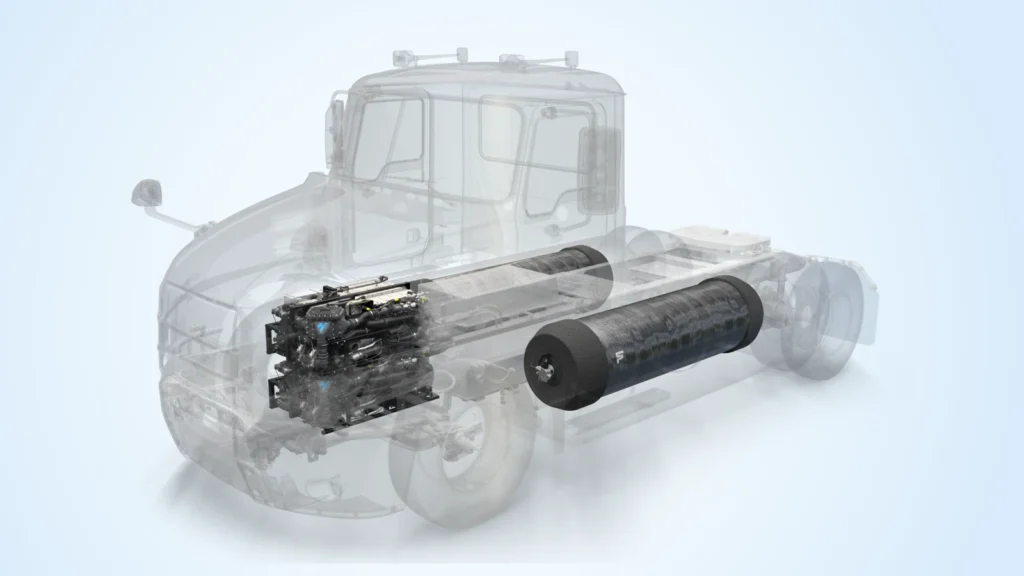
The concept film might still be speculative, but the logic already exists in practice – fleets running fixed routes, refuelling at central hubs, and proving the model one corridor at a time.
The trucks are already rolling
While the autonomous part is still in development, the base vehicle is no stranger to U.S. roads.
Hyundai already operates 30 XCIENT Fuel Cell trucks at the Ports of Oakland and Richmond as part of the NorCAL ZERO project, a deployment which the company says has clocked up nearly 450,000 miles since launching in September 2023 – all without a drop of diesel.
According to Hyundai, it remains the largest hydrogen truck programme in North America.
Further east, another 21 XCIENT trucks are working hauling new electric cars and parts at Hyundai’s new Metaplant in Georgia, running under the HTWO Logistics initiative with GLOVIS America.
They handle nearly half of the factory’s internal logistics and are powered by on-site hydrogen – a closed-loop system Hyundai says could be replicated globally, from port to plant to warehouse and beyond.

Both efforts fall under Hyundai’s HTWO brand – its broader commercial platform for scaling hydrogen mobility and infrastructure.
Not quite driverless – but not far off either
There’s no commercial launch date yet for autonomous hydrogen trucks, but Hyundai has the vehicle, Plus has the software, and both companies have real-world deployments proving their tech in the field.
The challenge now is integration – getting the systems to work together, and identifying the freight corridors where the numbers add up.
If that can be done, Hyundai and Plus believe hydrogen autonomy could finally start pulling its weight, offering a cleaner, quieter, and commercially viable alternative to diesel – one long-haul route at a time.