Australia’s first ‘beam-down’ solar reactor produces hydrogen at over 20% efficiency
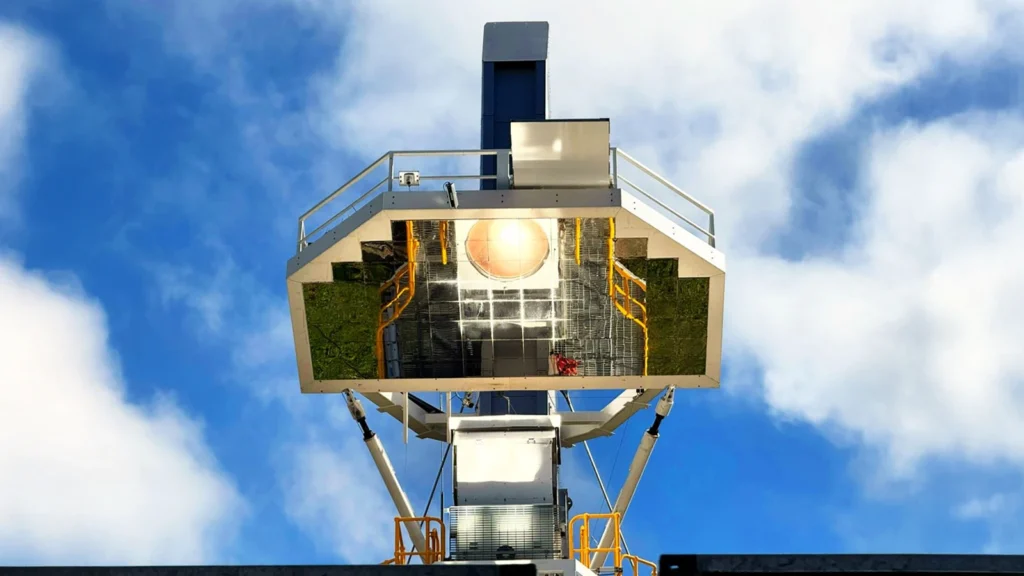
Australia’s national science agency has built and trialled a new solar-powered reactor that could help bring down the cost of green hydrogen – and power heavy industry using nothing but sunlight and steam.
The so-called beam-down system, developed at Australia’s national science agency’s (CSIRO) Newcastle Energy Centre with backing from the country’s Renewable Energy Agency (ARENA), uses concentrated solar energy and metal oxide particles to split water and generate hydrogen gas. It’s the first time this technology has been demonstrated in Australia.
Rather than relying on electricity, the process runs on heat alone – offering a thermochemical alternative to electrolysis that could simplify hydrogen production and cut costs at scale.
A new take on concentrated solar
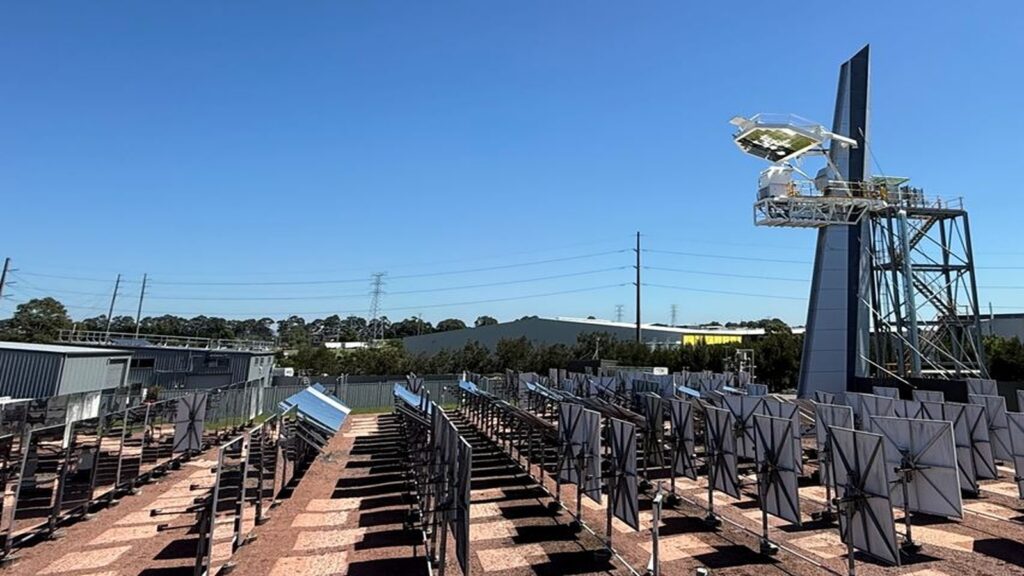
The reactor has sun-tracking mirrors – known as heliostats – that reflect light onto the top of a central tower.
A secondary mirror on the tower then directs the concentrated sunlight downward onto a reactor at ground level.
The scientists say it’s a reversal of the typical tower-based solar thermal design. With the receiver now on the ground, CSIRO engineers can more easily access and test high-temperature chemical reactions.
Inside the solar reactor: doped ceria at work
At the core of the system is something called a doped ceria, a metal oxide material developed at Niigata University in Japan.
When heated by solar energy, the ceria releases oxygen atoms. Introducing steam causes it to reabsorb oxygen from the water molecules, leaving behind pure hydrogen gas.
The particles can repeat this two-step cycle over and over.
“We can produce over three times more hydrogen than what’s typically achieved using standard materials in a similar reaction,” said Professor Tatsuya Kodama of Niigata University. “That shows real promise for improving efficiency in future designs.”
Potential for hydrogen production
Most hydrogen today is made from fossil gas via methane reforming – a high-emissions method known as grey hydrogen. Electrolysis offers a cleaner alternative but remains expensive and energy-intensive.
CSIRO’s solar-thermal method bypasses electricity altogether. In this initial trial, it demonstrated a full thermochemical water-splitting cycle – from sunlight to stored hydrogen – and showed potential solar-to-hydrogen efficiencies above 20%. That’s already better than many existing electrolysis systems.
“We’re not yet at industrial scale,” said CSIRO Principal Research Scientist Dr Jin-Soo Kim, who led the project. “But we’ve demonstrated strong reactivity under moderate conditions, and with further refinement, it could match electrolysis in both performance and cost.”
Beam-down can bring more than hydrogen
Because the receiver faces upward and sits on the ground, the beam-down system provides easier access for research. That opens doors beyond hydrogen – including metal refining, chemical synthesis, and high-temperature material testing.
“This is a significant leap forward for Australia’s solar thermal research capability,” said Dr Noel Duffy, leader of CSIRO’s solar technologies team.
Industrial sectors like steelmaking, iron, and aluminium refining use vast amounts of energy and are difficult to electrify. But with its abundant sunshine and space, Australia is well placed to scale up green hydrogen production using solar-thermal methods.
CSIRO’s beam-down reactor won’t replace electrolysis overnight. But it could complement it – offering a simpler, cheaper route to clean hydrogen, and helping to decarbonise sectors where few other options exist.