HRS sales fall after order cancellations – but international growth and 4-tonne station signal scale-up ahead
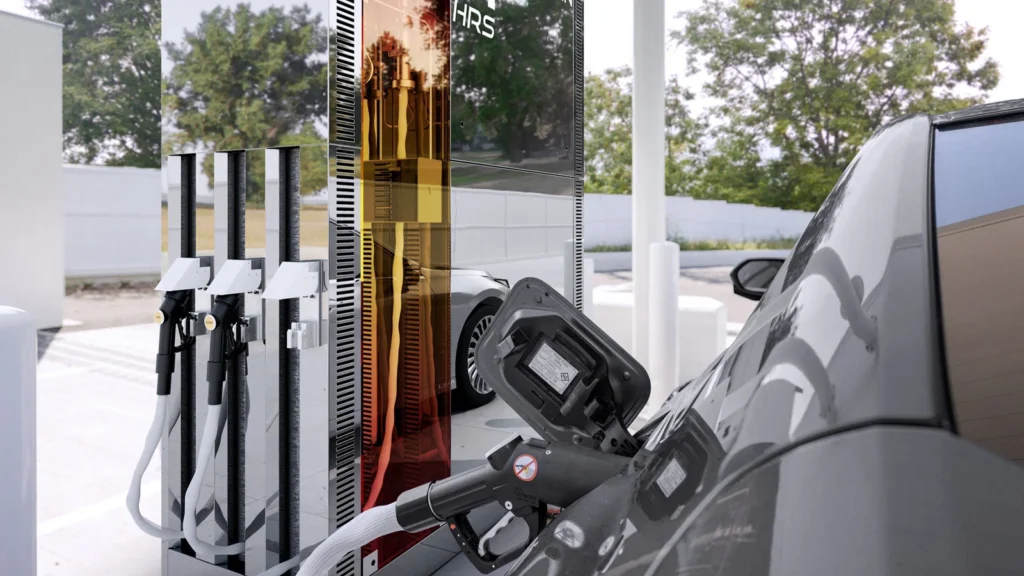
Hydrogen Refuelling Solutions (HRS) posted a sharp drop in adjusted revenue for the 2024-2025 financial year, following the cancellation of orders by multiple customers – but the company says its industrial base, international reach, and new high-capacity offerings have set the stage for future growth.
HRS reported gross revenue of €26.0 million for the year ending 30 June 2025, down 16% from €30.9 million the previous year.
However, once order cancellations and deprioritisations were accounted for, IFRS-adjusted revenue stood at just €11.3 million – a 54% drop compared to the 2023-2024 figure of €24.8 million.
The shortfall stems largely from the collapse or retreat of several hydrogen start-ups, including Hype, GCK and Hopium, which collectively cancelled orders totalling €11.2 million.
A further €3.5 million was removed from the books due to HRS’s decision to voluntarily deprioritise certain non-strategic projects.
Despite the financial hit, HRS said the affected stations remain in its possession and have been returned to inventory or reallocated to new customers, allowing the industrial value of the assets to be preserved.
“These adjustments… did not have any negative operational impact on HRS,” the company said. “This pragmatic approach has enabled the industrial value of the equipment to be preserved while optimising resource allocation.”
Sales still dominated by station delivery – maintenance up 56%
Out of the €26.0 million in gross sales reported, €23.4 million came from hydrogen stations, with maintenance revenue rising to €828,000, up 56% year-on-year. HRS now has 14 signed maintenance contracts, with a further 11 currently being finalised.
While the industrial piping and auxiliary business shrank to €1.8 million, HRS pointed to an expanding installed base and station reliability above 95% as proof of its maturing operational footprint.
The firm’s stations have now dispensed over 166 tonnes of hydrogen across Europe, refuelling 191,000 vehicles since 2022.
Ten new station orders – including Europe’s first 4-tonne/day site
HRS recorded €24.3 million in new orders during the year, with nearly 70% of that total coming from international markets – including the UK, Portugal, Saudi Arabia, and Italy.
Among the ten new station orders were:
- 1 HRS14 station for Element 2 in the UK
- 4 HRS14 stations for HYmpulsion’s Zero Emission Valley in France
- 1 HRS14 station for the Albility Lab carbon-free mobility centre
- 1 HRS14 station for the Kourou Space Centre in French Guiana
- 1 HRS160 station to support Europe’s largest hydrogen-powered public transport fleet
That last order – a 4-tonne-per-day refuelling station with six distribution points – represents a step change in capacity. It is expected to enter service in early 2026 and will be the first of its kind in Europe, according to HRS.
The company said it has now deployed 30 stations in total, up from 18 a year ago – a 67% increase in installed base since June 2024.

Strategic shift to less risk, more selectivity
The year’s financial wobble has prompted a strategic rethink. In response to volatile project execution and stretched customer budgets, HRS said it is now prioritising projects with firm installation schedules and proven payment capacity.
This new approach, alongside the company’s cost-cutting ‘Apollo’ transformation plan, is aimed at improving cash flow, reducing overheads, and accelerating the path to break-even.
Launched in early 2025, Apollo targets a 20-30% reduction in fixed costs, alongside digitalisation of internal processes, margin improvement, and enhanced commercial agility.
HRS has already identified €3-6 million in potential savings, and says Apollo will improve gross margin resilience and help absorb future market volatility.
€47.2 million order book and US ambitions
As of 30 July 2025, HRS’s order book stood at €47.2 million, including €11.4 million to be recognised on stations already in production. This excludes any stations linked to pHYnix, which entered judicial liquidation in June.
The firm is now forecasting IFRS revenue of €25-35 million for 2025-2026, with break-even expected in the middle of that range, aided by Apollo’s early impact.
International expansion also remains high on the agenda, with the company recently establishing HRS USA Inc, supported by a Bpifrance International Project Guarantee, and says it’s actively pursuing industrial and mobility opportunities across Europe, the Middle East, and North America.
Twin-nozzle tech, RHeaDHy project, and industrial market entry
HRS has continued investing in new product platforms to address emerging hydrogen use cases. Earlier this year, the firm launched two new offers:
- Export trailer – a mobile hydrogen refuelling trailer for remote or off-grid use
- Filling center – a modular hydrogen dispensing unit for industrial sites
The company is also involved in RHeaDHy, a European R&D consortium developing faster heavy-duty refuelling. HRS is working on prototype stations capable of refilling trucks in just 10 minutes, with parts already received for pre-assembly.
Separately, the company is co-developing Twin Mid Flow (TMF) technology with Toyota Motor Europe and ENGIE, enabling rapid refuelling of both cars and trucks from a single system. The first pilot TMF station will be tested later this year in Champagnier.