Saudi Arabia signs green hydrogen export deals with Europe
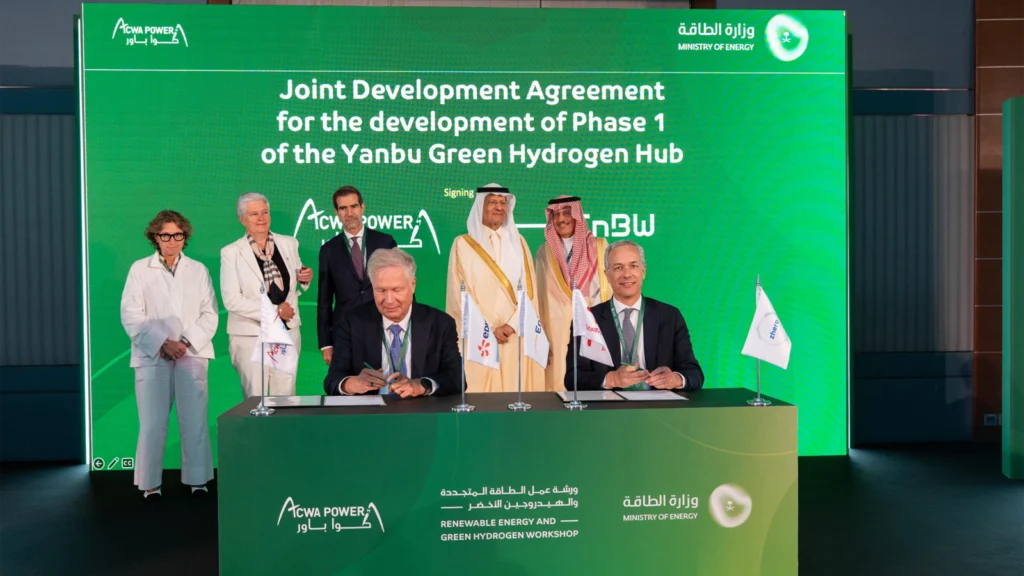
Saudi Arabia has signed a raft of new agreements with European energy firms to develop green hydrogen and renewable electricity projects for export – part of a broader plan to supply Europe via the planned India-Middle East-Europe Economic Corridor (IMEC).
The deals were signed in Riyadh at a government-backed workshop led by ACWA Power and attended by energy ministers and officials from France, Germany, and Greece, as well as executives from companies including TotalEnergies, Siemens Energy, and EnBW.
At the centre is a Joint Development Agreement between ACWA Power and German utility EnBW to build a large-scale green hydrogen production hub in Yanbu, on Saudi Arabia’s Red Sea coast.
The project will integrate dedicated renewable generation, desalination, electrolysis and ammonia conversion, with a dedicated export terminal – and is expected to begin operations in 2030.
Partnerships line up across Europe
In addition to the EnBW deal, ACWA Power signed a multi-party Memorandum of Understanding with Edison (Italy), TotalEnergies Renewables (France), Zhero Europe (Italy), and EnBW to evaluate demand and explore the feasibility of exporting clean energy from Saudi Arabia to Europe.
Several infrastructure firms also signed on to support the corridor’s physical development, with ACWA Power agreeing individual MoUs with high-voltage and transmission specialists including Prysmian, GE Vernova, Siemens Energy, Hitachi, and technical consultant CESI.

Together, the agreements aim to lay the groundwork for a cross-border energy supply chain – delivering clean power or hydrogen derivatives from the Gulf to European markets.
Energy Minister Prince Abdulaziz bin Salman attended the signing and said the deals reflect Saudi Arabia’s plan to become a reliable supplier of low-carbon energy and a key anchor in IMEC’s development.
From NEOM to Yanbu
While Saudi Arabia’s flagship NEOM Green Hydrogen Project – backed by Air Products – remains under construction on the east coast, the new Yanbu hub opens a second front, this time geared specifically toward European export routes.
The site benefits from Red Sea access, lower shipping distances to Europe, and proximity to desalinated water infrastructure – all critical factors for green hydrogen production at scale.
So far, the project’s backers haven’t disclosed production volumes, but describe it as a “fully integrated” export platform designed for long-term supply of green ammonia to international buyers.
It also forms part of Vision 2030, Saudi Arabia’s national strategy to diversify beyond oil, develop clean energy technologies, and build out industrial value chains.
IMEC corridor
The India-Middle East-Europe Economic Corridor (IMEC) was first announced at the G20 summit in 2023, backed by the US, EU, India, and Saudi Arabia.
It’s pitched as a multimodal transport and energy route connecting India to Europe via the Gulf and Israel – a potential alternative to the Suez Canal.
Saudi Arabia now wants to play more than just a transit role, and by investing in renewable generation, hydrogen conversion, and export terminals, the Kingdom aims to supply Europe directly with clean fuels and electricity.